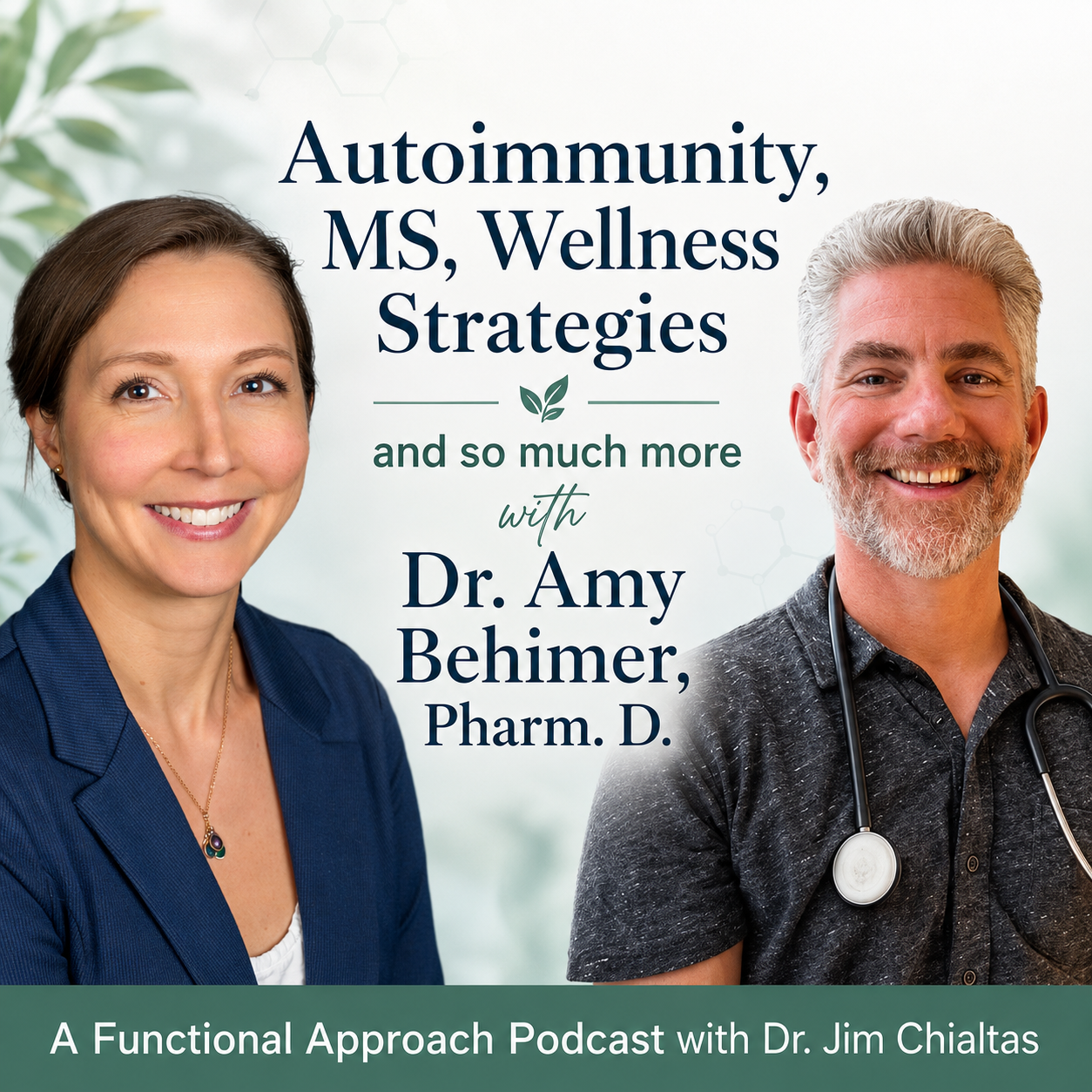
Autoimmunity, MS, Wellness Strategies, and So Much More with Dr. Amy Behimer, Pharm. D.
Autoimmune disease can feel overwhelming, confusing, and deeply personal. For many people, the journey begins with symptoms that are hard to explain, labs that do not tell the whole story, and a growing sense that something important is being missed.
In this episode of A Functional Approach, Dr. Jim Chialtas speaks with Dr. Amy Behimer, Pharm. D., a pharmacist, nationally board-certified health and wellness coach, Wahls Protocol Certified Practitioner, certified life coach, functional medicine certified health coach, and board-certified pharmacotherapy specialist.
Dr. Behimer also lives with multiple sclerosis, which gives her work a rare combination of clinical understanding, personal experience, and grounded compassion.
Together, Dr. Chialtas and Dr. Behimer explore the deeper side of autoimmune health, including MS, lifestyle medicine, mindset, connection, mitochondria, nutrition, and why small daily changes can become powerful tools for healing.
From Pharmacist to Functional Medicine Health Coach
Dr. Behimer first discovered functional medicine as a patient.
At age 27, she was diagnosed with her third autoimmune disease: multiple sclerosis. While she chose to use disease-modifying therapy as part of her medical care, she also wanted to understand what else she could do to support her body.
That question led her into functional medicine, lifestyle medicine, and eventually coaching.
As a pharmacist, Dr. Behimer already had a deep respect for conventional medicine. But as a patient, she saw the need for something more: guidance, support, and practical help turning health information into daily action.
Her work now focuses less on telling people what to do and more on helping them understand why change can feel so hard, even when the steps seem simple.
Why Overwhelm Is So Common in Autoimmune Disease
One of the biggest themes in the conversation is overwhelm.
Many people with autoimmune conditions are drowning in information. They have tried different diets, supplements, protocols, practitioners, and lab tests. They may have stacks of paperwork and bottles of supplements, but still feel unsure what is actually helping.
Dr. Behimer describes her superpower as helping people “uncomplicate” the process.
This is especially important because chronic illness often requires long-term lifestyle change. But when someone is exhausted, inflamed, foggy, or discouraged, even basic changes can feel impossible.
That is where coaching, support, and realistic steps can make such a difference.
Autoimmune Disease vs. Autoimmune Health
Dr. Behimer encourages people to rethink the way they relate to autoimmune disease.
Most people hear the word “autoimmune” and immediately fill in the word “disease.” But she offers another perspective: autoimmune health.
That does not mean pretending the disease is not real. It means noticing that health still exists within the body, even when disease is present.
The heart may still be beating well. The kidneys may still be filtering. The body may still have strength, resilience, and the ability to respond to support.
Dr. Behimer also points out that some people become healthier because of their diagnosis. They begin eating differently, moving differently, managing stress differently, and paying closer attention to their body.
A diagnosis can be painful, but it can also become a turning point.
The Importance of Connection
Autoimmune disease can feel isolating. Even loving family members may not fully understand what someone is going through.
Dr. Chialtas and Dr. Behimer discuss how connection can play an important role in healing. This can include family, friends, community, support groups, spiritual connection, nature, or simply feeling less alone in the process.
Connection also matters because lifestyle change is easier when the environment supports it.
If an entire household is moving toward healthier habits, the person with autoimmune disease does not have to feel like the “oddball” at every meal or every decision point.
What Is Multiple Sclerosis?
Dr. Behimer also explains multiple sclerosis in simple terms.
MS is an autoimmune disease that affects the central nervous system. In MS, the immune system attacks myelin, the protective coating around nerves. When that coating is damaged, nerve signals may not travel properly.
Symptoms can vary widely and may include:
Vision changes
Numbness or tingling
Pain
Weakness
Gait or balance issues
Brain fog
Fatigue
Changes in mobility
Because MS affects the brain and nervous system, it can have a major impact on quality of life.
The Role of Lifestyle in Autoimmune Health
Both Dr. Chialtas and Dr. Behimer emphasize that there is no single magic fix for autoimmune disease.
Instead, progress often comes from many small, consistent changes that add up over time.
Dr. Behimer describes this as “silver buckshot” rather than a silver bullet.
These small changes may include:
Eating more nutrient-dense foods
Supporting blood sugar balance
Improving sleep
Moving the body appropriately
Reducing ultra-processed foods
Building supportive relationships
Managing stress and mindset
Spending time in nature
Supporting mitochondrial health
For many people, the basics are not basic because they are unimportant. They are basic because they are foundational.
Mitochondria and Energy
One of Dr. Behimer’s favorite questions is:
“What would my mitochondria love?”
Mitochondria are often called the powerhouses of the cell because they help produce energy. When someone is dealing with fatigue, chronic illness, inflammation, or autoimmune disease, supporting mitochondrial health can be an important part of the larger picture.
For Dr. Behimer, this question became a practical decision-making tool.
It helped her choose foods, movement, rest, and habits that supported her energy over time.
Ultra-Processed Foods and the Body
Dr. Behimer also makes a powerful point about ultra-processed foods.
These foods are often engineered to be highly craveable and shelf-stable. But the additives and preservatives that help prevent bacterial growth may also create challenges for the body.
From a functional medicine perspective, food is not just about calories. It is information for the body.
The quality of that information matters.
The Wahls Protocol and Nutrient Density
The conversation also touches on the Wahls Protocol, developed by Dr. Terry Wahls, who also lives with MS.
The Wahls Protocol focuses heavily on nutrient-dense foods, lifestyle practices, movement, and other strategies designed to support cellular health.
A key part of the protocol is flooding the body with nutrients through food, especially vegetables and other whole foods. It also commonly removes gluten and dairy, which may be worth exploring for some people with autoimmune conditions.
Dr. Behimer is clear that not everyone can or should jump into an intensive protocol overnight. For many people, sweeping change without support can lead to frustration and self-blame.
Instead, she helps people adapt the principles into a realistic personal plan.
Autoimmunity Is Not Always Black and White
Dr. Chialtas also explains that autoimmunity can exist in phases.
Some people may have antibodies without symptoms. Others may be in a reactive phase where they feel unwell, but do not yet have a clear diagnosis. Others have a fully diagnosed autoimmune disease.
This is one reason functional medicine can be helpful. Rather than waiting until disease is severe, the goal is to look for patterns earlier and support the immune system, gut, brain, metabolism, and overall resilience.
Mindset Is Not “All in Your Head”
A major part of Dr. Behimer’s work is mindset.
She is careful to explain that symptoms are not imaginary. Autoimmune disease is real. Pain, fatigue, brain fog, and loss of function are real.
But the way we think about our illness can either add to our suffering or help reduce it.
Chronic illness often brings grief, fear, uncertainty, and frustration. Learning how to work with those thoughts and emotions can reduce the extra layer of suffering that comes from constantly fighting reality.
For Dr. Behimer, the book Loving What Is by Byron Katie was life-changing. It helped her see that arguing with reality often creates more pain, while learning to work with what is can create space for healing.
Low-Dose Naltrexone and Autoimmunity
Dr. Chialtas and Dr. Behimer briefly discuss low-dose naltrexone, often called LDN, which is sometimes used in the autoimmune world.
Dr. Behimer notes that her personal experience with it is limited, though she has heard some anecdotal reports of benefit, especially around fatigue and other symptoms. As with any medication, decisions about LDN should be made with a qualified prescribing provider who can weigh risks, benefits, and the individual’s health history.
A More Empowering Definition of Health
One of the most meaningful ideas from the conversation is that health should not be defined only by what the body can or cannot do.
Autoimmune disease can involve real loss. There may be changes in function, energy, mobility, or identity.
But Dr. Behimer encourages people to create a definition of health that includes what is still within their influence.
That shift can be powerful.
Instead of waiting for every symptom to disappear before feeling healthy, a person can begin building health now through choices, support, mindset, and self-understanding.
Final Thoughts
Autoimmune disease is complex. MS is complex. Chronic illness is complex.
But the path forward does not always have to be more complicated.
Sometimes healing begins with learning how to support the body in small, steady ways. Sometimes it begins with better food, better sleep, more connection, or a more compassionate way of thinking. Sometimes it begins by realizing that even with a diagnosis, there is still health to nurture.
This conversation between Dr. Jim Chialtas and Dr. Amy Behimer is a reminder that autoimmune care can be both scientifically informed and deeply human.
For people who feel overwhelmed, exhausted, or unsure where to begin, the message is hopeful:
You do not have to figure it all out alone.
Listen to the Full Conversation
Click on the player below for this episode of A Functional Approach with Dr. Jim Chialtas and Dr. Amy Behimer to hear more about autoimmunity, multiple sclerosis, mindset, mitochondria, lifestyle change, and creating autoimmune health.
Need Help Understanding Your Symptoms?
If you are dealing with brain fog, fatigue, digestive issues, autoimmune symptoms, or chronic health concerns that have not been fully explained, Dr. Jim Chialtas offers functional medicine consultations to help identify underlying patterns and create a personalized plan.
Schedule a free 15-minute consultation to see if working together is the right fit.