
How a yeast-derived peptide complex may help quiet “food noise,” support fullness, and complement healthier metabolic habits
Hello and welcome to A Functional Approach!
I’m Dr. Jim Chialtas, and I’m continuing my mini-series on peptides. In the first two articles, I explored BPC-157 and Copper GHK. Today, I’m turning to DNF-10, a yeast-derived peptide complex that has been studied for its potential to support appetite regulation, healthier body composition, and metabolic balance.
Weight Loss Should Be a Side Effect of Better Health
Throughout my clinical career, I’ve generally avoided making weight loss the central focus of care. Yes, I could market heavily around it, but I prefer to ask why the body is holding onto weight in the first place.
Sometimes the answer involves insulin resistance. Sometimes it is thyroid function, inflammation, disrupted sleep, chronic stress, medication effects, a highly processed diet, or a combination of several factors. When we improve the underlying physiology and build sustainable eating and movement habits, weight loss often follows as a positive side effect.
That does not mean targeted support has no place. A carefully chosen tool can sometimes give the body—and the person—a helpful push in the right direction. DNF-10 may be one of those tools.
What Is DNF-10?
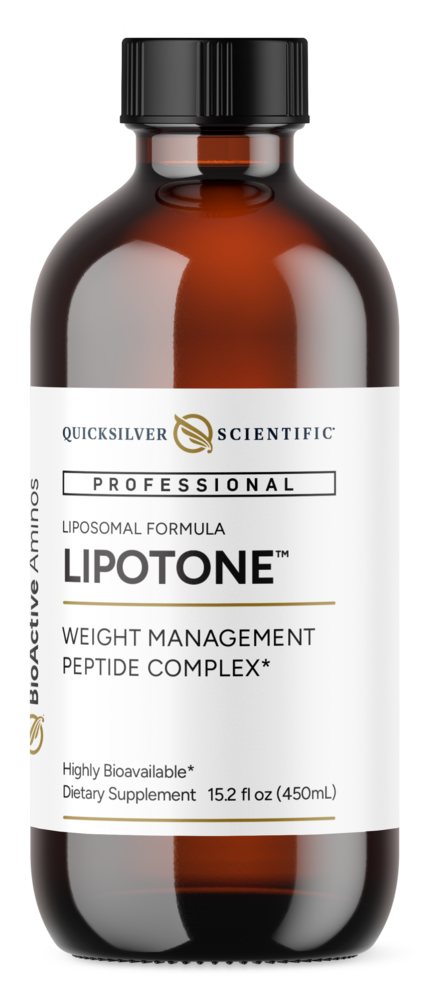
LipoTone, the product I use and recommend.
Available via my Fullscript supplement portal. Click here to shop.
DNF-10 is not a single synthetic drug-like peptide. It is a peptide-rich yeast hydrolysate derived from Saccharomyces cerevisiae. In simple terms, proteins from yeast are broken into smaller peptide fragments that may interact with signaling pathways involved in hunger, fullness, and energy balance.
The product I currently use is LipoTone from Quicksilver Scientific. Quicksilver is not a sponsor; I use the company because I value its attention to sourcing, testing, and delivery. That matters in the peptide world, where quality can vary significantly.
LipoTone combines DNF-10 with phosphatidylcholine in a liquid liposomal formula. Each 7.5 mL serving provides 250 mg of DNF-10 and 300 mg of phosphatidylcholine. The full labeled daily use—7.5 mL twice daily—provides 500 mg of DNF-10, the same daily amount used in one of the published human trials.
Hunger, Fullness, and “Food Noise”
Eating is not controlled by willpower alone. The gut and brain continuously exchange information through hormones, nerves, reward pathways, and metabolic signals. Ghrelin is one of the hormones involved in hunger and food-seeking. Cholecystokinin, often shortened to CCK, is released after food enters the gut and contributes to the feeling of fullness.
Preclinical research on yeast hydrolysates suggests they may influence several of these appetite-related signals. Small human studies also suggest that DNF-10 may reduce calorie intake, food cravings, and preference for very sweet foods. In everyday language, some people experience this as less “food noise”: fewer persistent thoughts about snacking, dessert, or what they are going to eat next.
That can be especially useful when someone genuinely wants to change but feels pulled back into the same eating pattern. Food can be rewarding, comforting, and habit-forming. A supplement cannot do the behavioral work for you, but it may make that work feel more manageable.
What Has the Human Research Shown?
One small randomized study followed 30 women with obesity for eight weeks. Participants who took 500 mg of yeast hydrolysate daily lost an average of about 1.6 kilograms, or 3.5 pounds, and showed reductions in body fat and calorie intake. Importantly, the study did not find a significant change in fat-free mass. Participants also reported less desire to eat and a reduced preference for sweetness compared with the control group.
Those findings are promising, but they need perspective. This was a very small, short study in a specific population. DNF-10 should not be presented as a proven obesity treatment, and we do not yet have the kind of large, long-term clinical trials available for prescription medications.
I see it as a potentially useful nutritional tool—not a magic weight-loss solution and not a substitute for medical care.
Why Preserving Muscle Matters
Whenever weight comes down, the number on the scale tells only part of the story. We want most of that change to come from excess fat while preserving as much lean tissue as possible.
Muscle supports strength, mobility, bone health, glucose regulation, and long-term resilience. It also releases signaling molecules called myokines that influence metabolism and many other systems. Losing substantial muscle can make a person lighter on the scale while leaving them weaker and less metabolically healthy.
The early DNF-10 research is interesting because the observed weight change was primarily associated with fat loss, without a significant reduction in fat-free mass in that small trial. Even so, no supplement replaces resistance training, adequate protein, regular movement, and sufficient recovery.
How Does This Compare With GLP-1 Medications?
DNF-10 should not be described as a natural version of Ozempic, Wegovy, Mounjaro, or Zepbound. Prescription GLP-1-based medications act through specific pharmaceutical pathways and have a much larger evidence base, stronger effects, established indications, and their own risks and benefits.
Studies of GLP-1 medications show that most weight loss comes from fat, but some people also lose meaningful lean mass. The amount varies across studies and individuals. That is one reason medical supervision, adequate nutrition, and strength training are so important during substantial weight loss.
I do not prescribe GLP-1 medications, and I am not suggesting that DNF-10 can replace them when they are medically indicated. I simply view DNF-10 as a gentler category of support that may be appropriate for some people who are working on appetite patterns and body composition.
The Role of Phosphatidylcholine
LipoTone also contains phosphatidylcholine, often abbreviated as PC. Phosphatidylcholine is a major component of cell membranes and contributes choline, an essential nutrient involved in normal lipid metabolism and liver function.
In this formula, phosphatidylcholine also helps create the liposomal delivery system—the tiny phospholipid spheres that carry the DNF-10 complex. Quicksilver uses this format to improve delivery and make the product easy to take orally.
My Experience With DNF-10
I have tried LipoTone myself. Weight loss was not my primary goal, but I was curious about its effect on evening eating—the familiar pull toward snacks while relaxing and watching television.
My experience was that it noticeably quieted that drive. I felt less compelled to keep looking for something else to eat after dinner. That is only one person’s experience, not clinical evidence, but it helped me understand why this formula might be useful for certain patients.
How LipoTone Is Used
The manufacturer’s suggested use is 7.5 mL by mouth 30 to 60 minutes before meals, twice daily or as directed by a healthcare professional. It is held in the mouth for 30 to 90 seconds before swallowing. I generally prefer to individualize use based on the person, the goal, and the rest of the treatment plan.
More is not necessarily better. Supplements can interact with medications, medical conditions, allergies, and treatment goals. LipoTone is yeast-derived, and the manufacturer advises people who are pregnant, planning pregnancy, or breastfeeding to consult a healthcare practitioner before use.
A Tool for Building a New Relationship With Food
The most interesting use for DNF-10 may not be rapid weight loss. It may be creating enough space for someone to practice a different pattern.
New habits take time. If a person can experience meals with better fullness, fewer cravings, and less reward-driven eating for several weeks, that may help them build a healthier relationship with food. The goal is not necessarily to remain dependent on the product forever. The goal is to use support strategically while improving diet, movement, sleep, stress regulation, and the underlying metabolic issues.
Is DNF-10 Right for You?
DNF-10 may be worth considering for someone dealing with persistent cravings, difficulty recognizing fullness, reward-driven eating, or stubborn body composition changes. But those symptoms can have many causes, and the right plan depends on the whole person.
If you are interested in trying LipoTone, I can evaluate whether it fits your health history, current medications, metabolic patterns, and larger treatment goals. Through an official functional medicine appointment, we can also look for factors such as insulin resistance, thyroid dysfunction, inflammation, food reactions, sleep disruption, or other obstacles that may be making healthy weight regulation more difficult.
I offer functional medicine consultations nationwide. If DNF-10 appears appropriate after assessment, I can help you obtain the professional product and use it as part of a more complete, individualized plan.
The Bottom Line
DNF-10 is an intriguing yeast-derived peptide complex with early evidence for supporting appetite regulation, reduced calorie intake, and healthier body composition. I am encouraged by its potential, especially as a short-term tool for people who are actively changing their relationship with food.
At the same time, the research is still limited. There are no easy tickets. The best results come when targeted support is combined with the fundamentals: a nutrient-dense diet, regular movement and resistance exercise, adequate protein, restorative sleep, stress management, and attention to the root causes of metabolic imbalance.
Interested in Peptides?
If you are curious about peptide therapy, Copper GHK, BPC-157, or whether these options might fit your health situation, Dr. Chialtas can help you evaluate what makes sense and make sure you are using high-quality products safely. He can review your health history, symptoms, goals, and safety considerations to help determine whether peptide support makes sense as part of your personalized plan.
Schedule a consultation or contact the office to ask about professional-grade peptide ordering options.
Research and Product Information
Jung EY, et al. Low Dose Yeast Hydrolysate in Treatment of Obesity and Weight Loss. Preventive Nutrition and Food Science. 2017;22(1):45-49. View source
Ahn Y, et al. Toxicity Evaluation by Single and Repeated Administration of Yeast Hydrolysate DNF-10 in Sprague-Dawley Rats. Preventive Nutrition and Food Science. 2021;26(1):75-81. View source
Quicksilver Scientific. LipoTone product information, supplement facts, and suggested use. View source
Bikou A, Dermiki-Gkana F, Penteris M, et al. A systematic review of the effect of semaglutide on lean mass: insights from clinical trials. Expert Opinion on Pharmacotherapy. 2024;25(5):611-619. View source
This article is for educational purposes only and is not intended to diagnose, treat, cure, or prevent disease. Dietary supplements are not a substitute for individual medical care. Always consult a qualified healthcare professional before starting a new supplement or changing a prescribed treatment.