The Shortcut and the Cost: My Experience with the GLP-3 Peptide, Retatrutide

This article is adapted from an episode of my podcast, A Functional Approach, in which I share what happened when I tried an investigational peptide called retatrutide.
I'm a curious person. I like understanding how things work, and sometimes that curiosity leads me into experiences I wouldn't necessarily recommend to someone else.
That's how I found myself trying retatrutide.
I wasn't looking to lose a substantial amount of weight. I'm active, I exercise regularly, and I didn't have much weight I wanted to lose. What interested me was the possibility of changes in blood sugar, cholesterol, and body composition—and the experience of taking something that could change my relationship with food.
I planned to give it six to eight weeks, with bloodwork and body measurements before and afterward. I stopped at about five.
The results surprised me. So did the discomfort. And perhaps most surprisingly, even after deciding that it wasn't a good fit for my body, part of me wanted to keep going.
What is retatrutide?
You may have heard retatrutide called “GLP-3.” That's an informal nickname, rather than a scientific drug classification. More accurately, it's a triple hormone receptor agonist, acting on the receptors for GLP-1, GIP, and glucagon. [1]
That distinction matters: it isn't simply another name for Ozempic, and the benefits and risks of different medications shouldn't be treated as interchangeable.
As of October 2026, retatrutide remains investigational and is not FDA-approved. Its safety and effectiveness are still being evaluated in clinical trials. [1]
I obtained the product I used outside a clinical trial, through a contact I trusted. That's part of my story, but it isn't an endorsement of that route. Trust in a supplier or a claim of third-party testing doesn't establish that an unapproved injectable is safe, sterile, or accurately dosed. Products sold outside the clinical-trial system also can't be assumed to be equivalent to the medication being studied. [1]
I'm sharing a personal experience, not a dosing protocol. Prescribing or administering injectable retatrutide is outside my scope of practice.
I felt it much sooner than I expected
I was told that I probably wouldn't notice much at the amount I started with.
I noticed it almost immediately.
By dinner the next evening, I had very little interest in eating. I ate anyway, and afterward I felt overly full. Over the following nights, that pattern became more pronounced. Even a small meal could feel like too much.
I'm a physically active man approaching 51. I wanted to eat enough to support my workouts and my day, but my appetite simply wasn't cooperating.
Then came the reflux.
I have a mild hiatal hernia, and I don't usually experience much reflux. During this experiment, however, food seemed to sit in my stomach for a long time. Several hours after dinner, I could still feel uncomfortable enough that lying down wasn't appealing.
One night, I wanted to go to bed, but dinner was still talking to me. I tried lying down, got back up, and spent more time sitting on the couch until I felt comfortable enough to sleep.
Gastrointestinal side effects are also reported in retatrutide trials. [2] In my case, they were a substantial part of the experience.
The cost extended beyond my stomach
By the third week, I noticed muscle fatigue and soreness, even on days when I hadn't exercised. I also felt less emotionally resilient. Work stress, family stress, and the noise of the world seemed heavier than usual.
I can't establish exactly why that happened. I was eating much less, feeling physically uncomfortable, and sometimes having trouble settling down at night. Those things were all happening together.
But I could tell that I wasn't feeling like myself. My wife could tell, too.
At one point, she asked whether we could take a vote that I stop taking it.
That got my attention. My experience was affecting more than my measurements. It was affecting how I showed up at home.
I attempted to reduce the amount I was taking, but made a preparation mistake and ended up taking the same amount again. That was a sobering reminder of how easily self-administering an unapproved product can go wrong.
When I subsequently reduced it as intended, most of my gastrointestinal symptoms became less intense. They didn't disappear, though. Ultimately, I decided to stop.
What changed in about five weeks?
Here's where the story gets complicated: several of my measurements improved considerably.
I looked leaner within the first couple of weeks. My pants fit differently. My waist decreased by about an inch, and by the end I estimated that I had lost roughly eight pounds.
My bloodwork changed, too. I have a history of persistently elevated cholesterol, so some of those findings were especially striking to me.
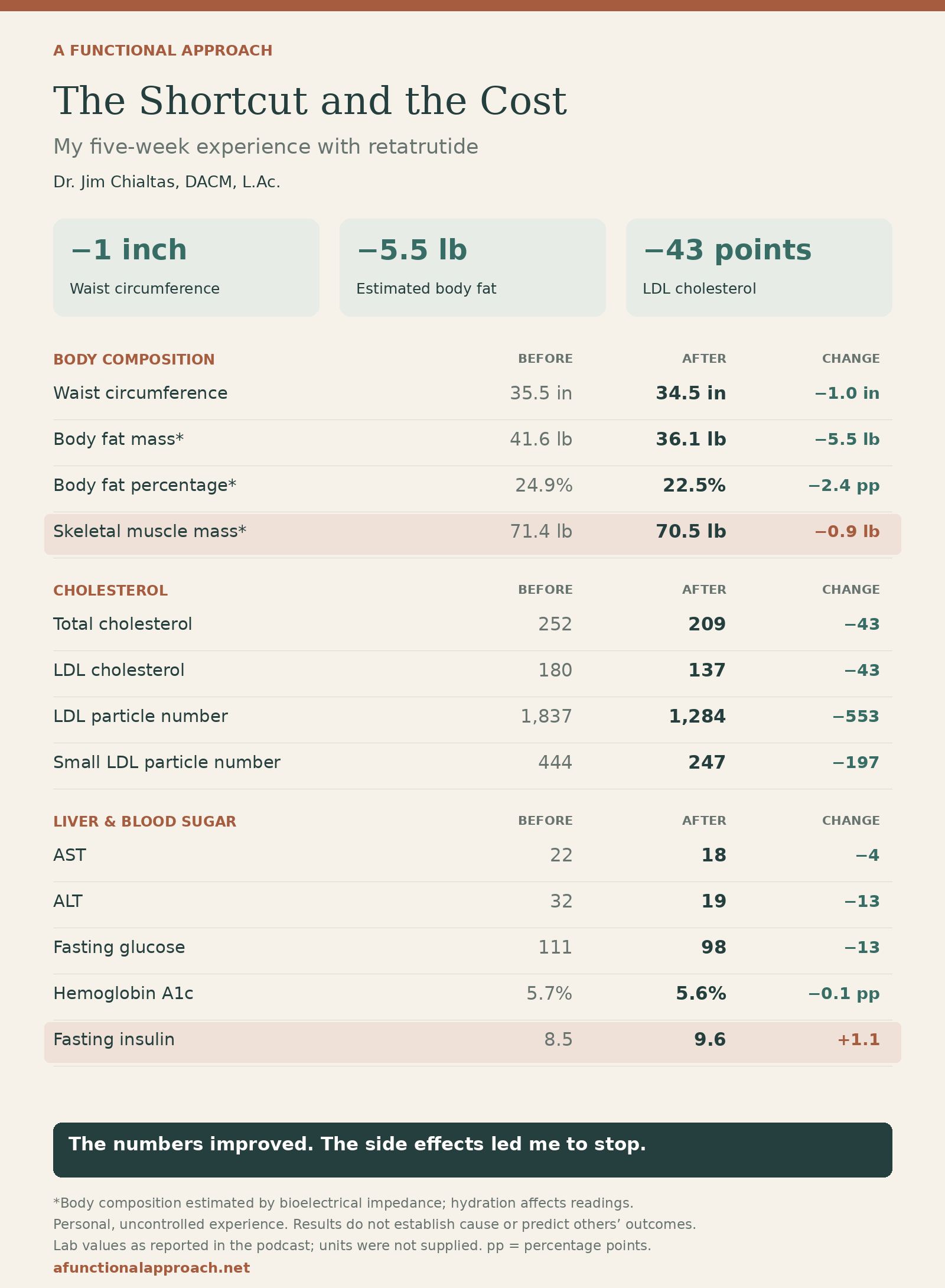
My first reaction was: holy moly.
I was impressed by how quickly these changes happened. But this was one person's uncontrolled experiment. I was also eating substantially less. These results don't tell us how much each factor contributed, what someone else would experience, or whether the changes will persist.
Lower liver enzymes also don't prove that I lost liver fat, and improved cholesterol numbers don't establish how much my long-term cardiovascular risk changed. My LDL remained elevated and still deserves attention.
My fasting insulin rose slightly. I noticed that, but a pair of test results can't establish the reason.
The scale didn't tell the whole story
The body scan estimated that I lost about 5.5 pounds of fat and just under a pound of skeletal muscle.
I wasn't trying to lose muscle. I continued working out three to four times a week, including resistance exercises, and made an effort to prioritize protein even when I didn't feel like eating.
These scans are estimates, and changes in hydration can affect them. I can't claim that every fraction of a pound represents actual muscle tissue lost. Still, that finding, alongside the fatigue I was feeling, mattered to me.
If all I had tracked was my weight, I would have missed that part of the picture.
A lower number on the scale wasn't enough for me to call the experiment a success. I also wanted to feel strong, nourished, and capable of doing the things I enjoy.
The part I hadn't anticipated: wanting to hold on to the results
I liked how I looked. I'll be honest about that.
My abdomen was more defined. I looked leaner, and it felt good to see the change. But when I decided to stop, a little voice started negotiating:
What if it all goes back? Maybe I could find a way to keep taking just a little.
That was interesting—and uncomfortable—to notice. I knew I didn't feel well on it, yet I was considering ways to continue because I liked the results.
I'm not saying that this establishes addiction or a psychiatric diagnosis. I'm describing the pull I felt between enjoying a new appearance and listening to a body that wasn't enjoying the process.
Food had changed, too. Less interest in eating meant less interest in some of the ordinary pleasures that come with it: enjoying dinner, anticipating a favorite meal, feeling satisfied and nourished afterward.
For me, those experiences have value. They belong in the discussion alongside waist measurements and lab results.
Was the shortcut worth it?
For my body, at this point, the cost was too high to continue.
That doesn't erase the improvements I observed. And it doesn't tell me what the balance would be for someone with a different medical history, a different response, or a substantial need for weight reduction.
It does leave me with a question I think we should ask whenever a treatment produces impressive results:
What is changing, how do I feel, and what am I giving up to get there?
Medication can be an important part of medical care. People deserve an informed conversation about appropriate, approved options with a clinician who can prescribe and monitor them. My experience with an investigational product isn't a substitute for that conversation.
For now, I want to regain my usual appetite, feel comfortable after meals, and see what happens to my strength, measurements, and bloodwork over the next few months.
That follow-up is part of the story, too. Five weeks of results can't answer the question of sustainability.
I came away impressed by the changes on paper and clear that I didn't want to keep feeling the way I felt. Both observations deserve to be heard.
About Dr. Jim Chialtas
I'm Dr. Jim Chialtas, DACM, L.Ac., and I practice Functional Medicine and Acupuncture in San Diego, California. Through A Functional Approach, I help patients better understand their health through thoughtful assessment, lab interpretation, nutrition, and individualized support. I offer virtual and in-person appointments.
If you would like help making sense of your metabolic health or lab results, please schedule a discovery call or an appointment. I look forward to working with you!
Sources
Eli Lilly and Company. What to know about retatrutide. Updated September 2026.
Jastreboff AM, et al. Triple–Hormone-Receptor Agonist Retatrutide for Obesity—A Phase 2 Trial. New England Journal of Medicine, 2023.
This article is for educational purposes only and is not intended to diagnose, treat, cure, or prevent disease. Peptide products and uses may not be FDA-approved for the purposes discussed. Consult a qualified healthcare professional before beginning any new therapy, especially if you are pregnant, breastfeeding, taking medication, or managing an autoimmune or other medical condition.
Schedule a consultation or contact the office to ask about professional-grade peptide ordering options.